
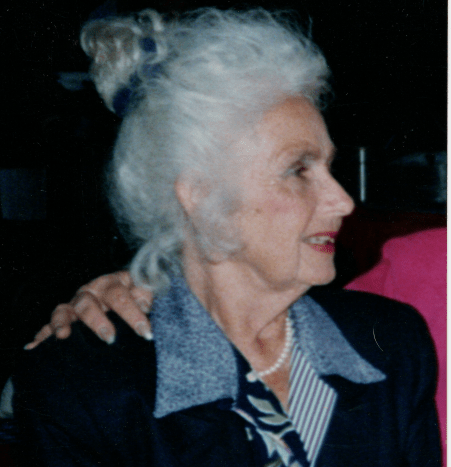
I remember when I was young feeling I might actually die if I were to lose her, lose Mama. She was closer to me than anyone, closer than my own skin.
This is about my mama and her imprint on my soul. The lessons of love were not impressed on me through admonitions, though those were administered on a regular basis – don’t bite your nails, get your hair out of your eyes, stand up/sit up straight. Her lessons were taught through example. The first was lying leads to hurt feelings. So, Mama did not lie and did not tolerate it in others. However, the second rule, don’t hurt someone’s feelings if you can help it, often made it hard to keep the first rule. The third was the most important. Love is important, be sure the ones you love know you love them by your actions. Those Mama loved knew how she felt. I continue to reap the benefits of these lessons every day.
In 1966 my mom decided to enter the workforce in order to cover the extra expenses that came with having a child in Jr. and Sr. High School. She was 43 with little experience and no relevant skills; her first job was working at the counter of a dry cleaner taking in dirty coats, jackets and trousers. It lasted three weeks before she could not turn out another nasty trouser pocket. She quit. Next, she sold shoes, comfortable in the job that requires one to humbly kneel and handle another person’s feet. She earned the respect of coworkers and supervisors; she had return customers that would only buy their shoes from her as she expounded on the importance of a proper fit. These were some of my happiest years. I loved shoes, and her short experience in the shoe department returned massive rewards later on in my life when she appointed herself sole (insert tongue in cheek here) shoe czar for my kids.
While working in shoes, a department head position opened up in the garden shop. Not long after taking the position she suffered a back injury that sidelined her, and she retired from working in the public sector. Having gotten a taste of independence in the real world she found life at home waiting on my dad unbearable. She loved kids, so babysitting for young families was a natural choice. She only took up smoking and drinking when my father left her for horse-faced Dorothy. She continued to babysit; the money kept her in cigarettes, beer, and Planter’s peanuts. This makes her sound crusty and hardened. She was not.
Smoking calmed her, she said; and peanuts provided some semblance of a healthy diet (protein and salt); beer, her carb of choice, rounded out what she referred to as a balanced-enough diet. Mama found value, validation, and dignity in helping others raise happy healthy kids. Beyond peanuts, beer, and smokes, she used her earnings to provide my children with all those shoes, and a “love” allowance each week. In spite of these indulgences, her savings grew, and she was able to build a “granny pad” on the back of our home where she lived the last few years of her life. She stopped smoking, beer became a treat for hot days, and cashews, her favorite, replaced the cheaper peanuts. While living with us, she provided a stability often missing in a lot of homes. Mama didn’t start her workday with her other families until my kids were up, dressed appropriately, fed, and off to school.
This sunny warm day was one of the last pieces of her journey.
Life is divided into eras – “pre,” “mid,” and “post.” Up to this point we had been living in the “pre cancer” era; for Mama it lasted 70 years. In June,1993, she decided it was time to retire from babysitting and enjoy her life and space. She enrolled in a yoga class and Spanish 1 at the Senior Center. Three months later she was diagnosed with a bilateral glioblastoma brain tumor living and growing in her head. We were thrust into the “mid” phase of living and dying with cancer; it lasted eight months. For her, there would be no “post cancer” era.
The tumor was inoperable, and chemo was not advised. Radiation was the only option, albeit a poor one. In retrospect I would have counseled her against it, the impact on her quality of life was devastating. No amount of zapping could alter the end result. She died the following April, the day after her 71st birthday. I have been living in the “post” era almost 30 years now. Mind blowing. I thought I couldn’t live without her, without my protective skin. Apparently, I can, but I miss her. And as I turn 72 the reality of how short life can be hits me like a freight train.
She was afraid during those nine months; the fear became her motivation. She decided exercise was the answer, performing her workout routine by going up and down the stairs in our backyard. One day she was outside longer than usual. I went out to check on her. She was at the bottom of the wooden steps, just staring at the first step.
“Mama, what are you doing?” She startled a little as I broke her concentration. She looked up trying hard to focus.
“I don’t remember…remember how to…”
I went down, took her elbow and talked her through the task. She couldn’t remember how to go up the steps, but some piece of her brain told her to never go down them again, so walking, more like creeping, became her medicine. She would make it to the stop sign where our street T-boned the arterial then turn around and to make her way back home. The two-blocks took her a half hour. Sometimes I walked it with her, sometimes I watched her from the front porch when she wanted to show me how independent she was, how much better she was doing. She wasn’t.
Then I came home from work one day, dropped my purse, kicked off my heels and grabbed a Silver Bullet from the fridge before heading back to Mama’s pad. It was too quiet in the house…never a good sign. My husband was probably in the garden below, his version of meditation, but at least two of the three kids were usually home from school fighting over something, with gramma in the back watching her shows. Today there was nothing. Okay, gardening is a quiet activity, and the kids were probably making noise in some other mother’s house, but this was eerie. I walked through the portal. No laugh-track blaring from her TV, no country music from the old radio on the nightstand. Lights on, no one home. Like I said, not a good sign. Fear burbled up, the Coors Light an accelerant. I swallowed hard and began searching for clues.
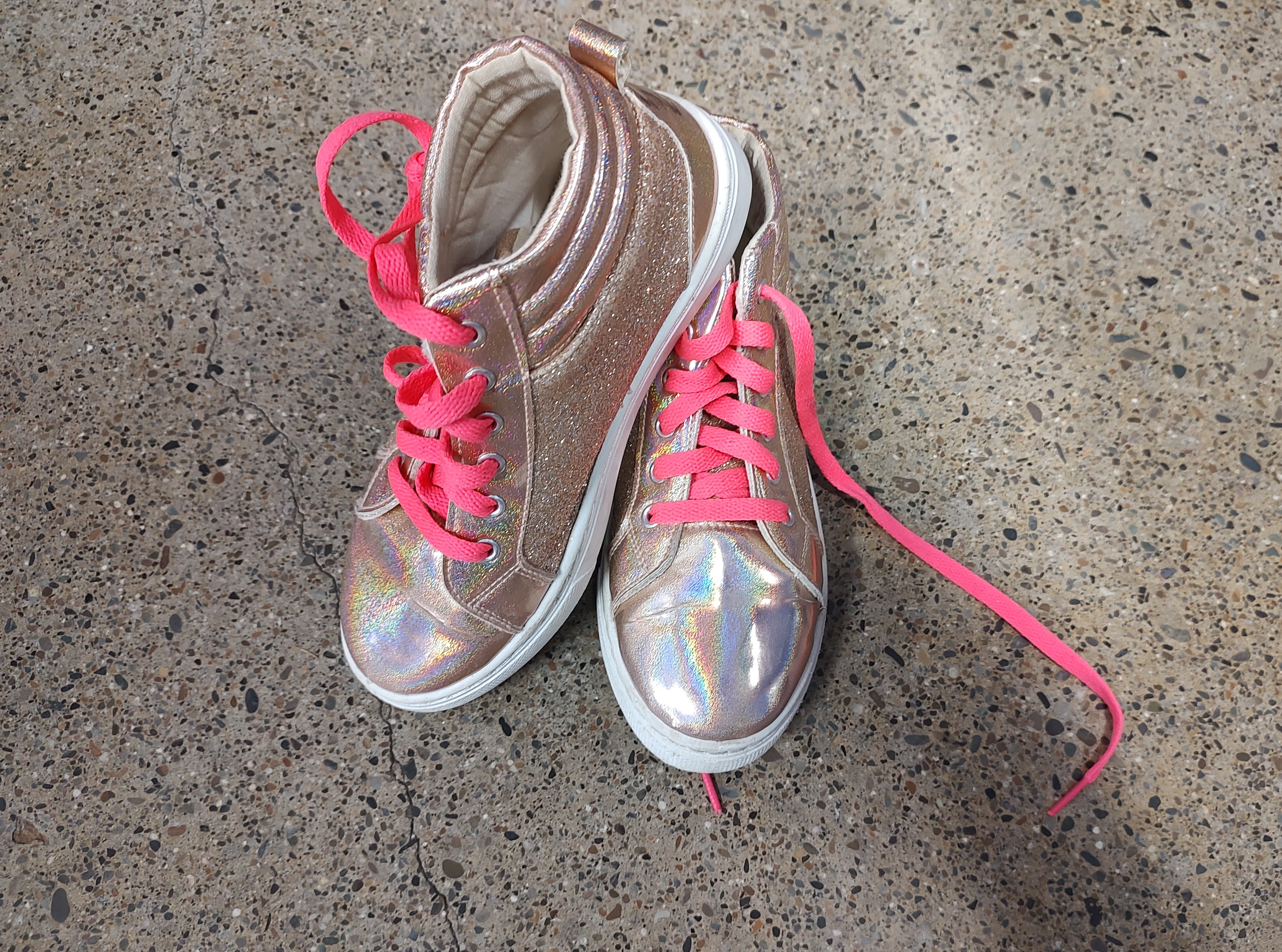
Her favorite walking shoes, the gold lame Keds, were missing from her closet. I would have noticed her if she had been on the sidewalk as I turned down our street. I couldn’t have missed the frail body listing to port, couldn’t have missed the blue bandanna tied over her radiated bald spots. I ran to the front of the house, jabbed my feet back into my shoes, grabbed the keys and purse off the floor, got back in the van and made quick turns up and down the nearby streets. Frantic, I headed back to the house to call 911.
On the way I spotted her sitting on the curb in front of a truck only two doors down. I had missed seeing her because of the truck. She stopped to rest, forgot which way she was going, and sat down. I pulled over, put the van in park, and walked around to help her up. I opened the van door and half lifted her in.
Thankfully, I saw recognition in her eyes. She asked, “Where are we going?”
“Home, Mama. We’re going home.”
I opened the front door repeating my earlier actions – keys, purse, shoes, and yes, I did deserve a second Bullet, the first still sat warming on the counter where I had left it. I hate to drink alone so I grabbed one for Mama. I turned to hand it to her. She was already through the portal. I followed and found her sitting on the flowered loveseat. Sighing, I sat on the end of her bed and handed her the opened can. I noticed her eyes had been slowly changing in the last few days from the warm brown I loved to this new shade of vacant gray. She held the beer and smiled, lost, staring at the view through her window.
“Mama, where were you going? You didn’t leave me a note. I was worried.”
Those graying eyes met mine. “For a walk.”
“But you always leave me a note.” In the pre-cancer era, she always left us notes. They were love notes because she didn’t want us to worry.
“I do? Oh.” She shook her head slowly, cognition just beyond her reach.
“No. I did.”
“I looked, Mama. I didn’t find one.”
I watched her try to remember. Then she reached her hand into her jeans pocket and pulled out a slip of crumpled paper. The half smile returned. “See?” she held it up, her last love note to me.
It was still months before her body would give up entirely and succumb to the inevitable, before she would forget to be afraid. I didn’t know that I still had time with her, I just knew that every day felt like the end.
Her last love note was much more revealing and poignant than I realized at the time. The moment she pulled it from her pocket was the very moment she let go of her conscious fight against the inevitable journey we all embark on from the moment of our conception. Her note, eloquent in its simplicity, beautiful in its significance, represented her unconscious acceptance. She had worn her gold Keds for the last time.
She didn’t need to tell me; like her, I knew in my heart. There would be no more love notes. There was only one last destination. I took it from her fingers and read it.
“Have gone, mom”
 Never at a loss for words...